
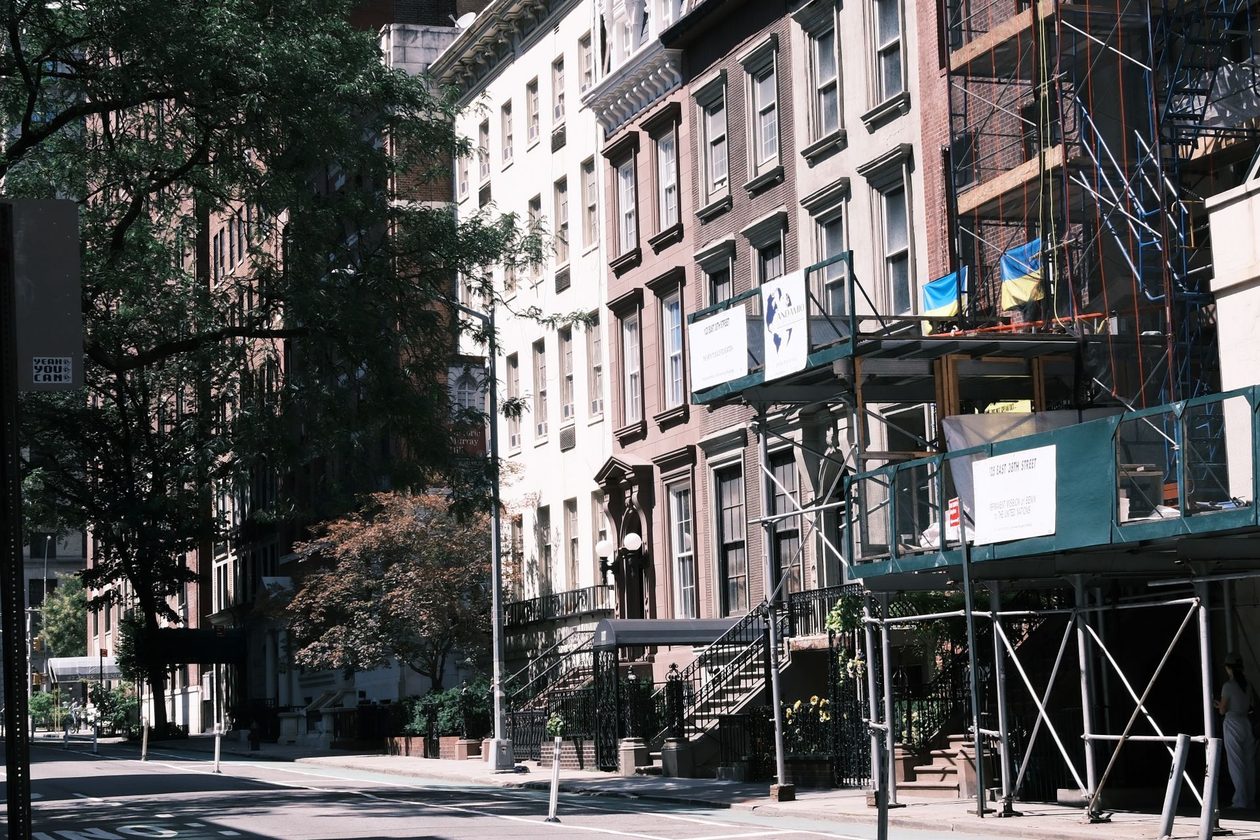
Manhattan rewards preparation and punishes improvisation. A renovation that would be straightforward in a low-rise building becomes a different job entirely when the space sits twenty floors up, the only way in is a booked freight elevator, and every delivery has to cross a busy sidewalk on a schedule the building controls. Hiring a general contractor in Manhattan means hiring someone who understands that the building itself is a second client — with its own rules, its own calendar, and its own say over when work can happen. Here is what a commercial general contractor has to get right before the first tool reaches the floor.
Every Manhattan high-rise has its own rulebook
Before pricing the work, a general contractor in Manhattan reads the building's alteration rules. Most commercial buildings publish a set of requirements for construction: the hours when noisy work is allowed, the insurance certificates that must be on file before anyone sets foot on site, the protection that has to cover floors, walls, and elevator cabs, and the approvals the landlord or building management must give to the drawings before a permit application moves forward. Those rules vary from building to building, sometimes sharply, on the same avenue.
That is why an experienced NYC general contractor asks for the building rules at the first meeting, not after the contract is signed. The rules shape the schedule, the staffing, and the budget. If noisy work is limited to certain hours, demolition and drilling are planned inside those windows. If the building requires its own review of the plans, that review time belongs in the programme from the start. A general contractor who discovers the rulebook late discovers the delays that come with it.
The freight elevator is the project's lifeline
On a Manhattan high-rise job, almost everything — workers, tools, sheet goods, fixtures, debris — moves through one freight elevator, and that elevator is shared with every other tenant and contractor in the building. A general contractor books freight time the way other projects book inspections: early, in writing, and with a plan for what each run carries. A missed booking is not a small inconvenience; it can idle a crew for a day and push every trade behind it.
Good planning shows in the details. A commercial general contractor sequences deliveries so material arrives in the order it will be installed, sizes loads to the elevator cab and the building's doorways, and schedules debris removal so waste does not pile up in a space that has nowhere to store it. Where the building allows only one contractor in the freight car at a time, or reserves certain hours for tenant use, the general contractor builds the working day around those windows instead of fighting them. When you are hiring, ask a simple question: how will material and debris move through this building? The answer tells you whether the contractor has actually run a high-rise job.
Tight sites leave no room for storage — or mistakes
Manhattan sites are tight in every direction. There is rarely a yard, a spare room, or a quiet corner for staging, and the street outside may allow only a short window for a truck to stand. A general contractor in NYC therefore plans just-in-time delivery as the default: material comes up when the crew is ready for it, protection goes down before it moves, and finished work is covered the moment the next trade needs the same space.
Tight sites also raise the cost of a wrong measurement. A cabinet, a length of duct, or a sheet of stone that cannot make the turn in a corridor or fit the freight cab becomes a problem with no easy workaround. A careful general contractor verifies the route — lobby, elevator, corridor, doorway — before ordering anything large, and confirms dimensions on site rather than trusting an old drawing. On a tight Manhattan floor, the route is part of the design.
Working hours, noise, and the neighbours above and below
A Manhattan commercial renovation rarely happens in an empty building. Offices above, below, and beside the work keep operating, and the building's rules on noise, dust, and working hours exist to protect them. A general contractor plans the loudest work — demolition, cutting, drilling — inside the hours the building permits, and sequences quieter work, such as fitting, finishing, and painting, around it. Dust control, sealed openings, and daily cleaning of shared routes are not courtesies; they are conditions of being allowed to keep working.
Communication is part of the same discipline. Building management should know, in advance, when a noisy phase starts, when a delivery will hold the freight elevator, and when a shutdown of a shared service is needed. A general contractor who keeps management informed hears about a problem while it is still small. One who surprises the building finds the rules enforced the hard way.
Permits, insurance, and the paperwork Manhattan checks twice
High-rise commercial work sits under the same New York City Department of Buildings requirements as any other job — filed plans, permits before covered work begins, and inspections at the right stages — with the building's own paperwork layered on top. Certificates of insurance naming the parties the building requires, signed alteration agreements, and approved drawings may all have to be in place before the first delivery is accepted at the loading dock.
When hiring a general contractor in Manhattan, verify the basics directly: ask what will be filed with the DOB for your scope, who schedules the inspections, and what insurance documentation the contractor will provide to your building. Art-Tech Construction Corp works under NYC DOB Insurance Tracking #623925 — an insurance tracking number, stated plainly for what it is. A general contractor should be equally plain about every document you ask for, and should treat the building's submission package as part of the job, not as your problem.
Questions to ask before you sign in Manhattan
A short set of questions will separate a general contractor who knows Manhattan high-rises from one who is about to learn on your project. Ask how they book and protect the freight elevator, and what happens to the schedule when a booking is lost. Ask how deliveries and debris are handled on a street with no standing room. Ask which building rules they have already read for your address, and what those rules do to the working hours. Ask how noisy phases are phased around your neighbours, and who speaks to building management when something changes.
Listen for specifics. The right answers name the building's documents, the elevator, the route, and the calendar — not just the trades and the finishes. In Manhattan, the construction work itself is often the most predictable part of the job. It is the logistics around it that decide whether the programme holds.
Art-Tech Construction Corp is a general contractor in NYC, founded in 2017 and working under NYC DOB Insurance Tracking #623925, handling A-to-Z renovation and new build work across the five boroughs — commercial first, including offices, schools, institutions, retail, restaurants, and warehouses, with residential work as a secondary service. If you are planning a Manhattan project and want a general contractor who reads the building rules before pricing the work, call (212) 960-3895 for a free consultation and a free written quote. Bring the building's alteration rules to the first conversation, and we will build the programme around them.
Planning a project like the ones described here? Start with a free consultation and a free, detailed quote — call (212) 960-3895 or use the contact form.